


Prosciutto di Parma vs San Daniele: DOP & IGP Guide

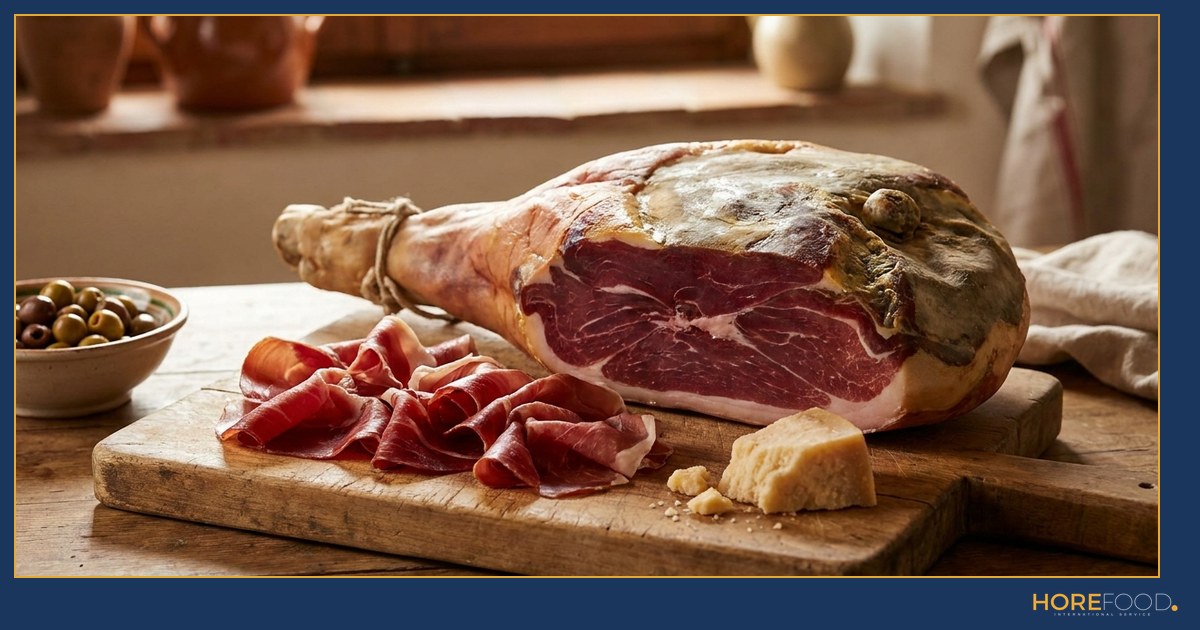
If you buy or resell Italian cured meats, “DOP” and “IGP” on the label are not marketing badges — they are EU-protected quality schemes that change what is inside the pack. This guide explains DOP (PDO) vs IGP (PGI) in plain terms, then compares the two most-asked-for Italian hams: Prosciutto di Parma vs Prosciutto di San Daniele, and what the differences mean for you when you sell them on.
This guide is general trade information, not legal advice. Product specifications are set by each Consorzio and EU law and can change — always confirm the current specification before you make purchasing or labelling claims.
What do DOP (PDO) and IGP (PGI) actually mean?
DOP (Denominazione di Origine Protetta / PDO in English) means every stage of production, processing and preparation must take place in the defined geographical area; IGP (Indicazione Geografica Protetta / PGI) means at least one of those stages happens there. Both are protected under Regulation (EU) No 1151/2012 on quality schemes for agricultural products and foodstuffs. In practice, DOP signals the strongest, most complete link to a specific territory, while IGP allows part of the supply chain to sit outside the region.
- DOP / PDO — raw materials and the full process are tied to the named area.
- IGP / PGI — at least one stage (production, processing or preparation) occurs in the area; reputation or a specific quality is linked to it.
- Every registered name is listed in the EU’s official eAmbrosia register, with the legal act and the product specification attached.
Are Prosciutto di Parma and San Daniele DOP or IGP?
Both Prosciutto di Parma and Prosciutto di San Daniele are DOP (PDO) — the highest tier, not IGP. Each is made only from Italian pork and salt, with no preservatives, additives, nitrates or nitrites, and each is aged and certified inside its own protected zone. That shared DOP status is why they command a premium and why buyers ask for them by name.
How do Prosciutto di Parma and San Daniele differ?
The two hams come from different regions, take different shapes, and age for different minimum periods — differences your customers can see and taste. Parma comes from Emilia-Romagna and is trimmed to a rounded shape; San Daniele comes from Friuli Venezia Giulia and keeps its trotter (the “zampino”) attached, giving it a distinctive guitar-like silhouette.
| Feature | Prosciutto di Parma DOP | Prosciutto di San Daniele DOP |
|---|---|---|
| Region | Emilia-Romagna (province of Parma) | Friuli Venezia Giulia (San Daniele del Friuli) |
| Pigs | Heavy Italian pigs, born and raised in designated central-northern Italian regions | Heavy Italian pigs from the same designated Italian regions |
| Ingredients | Italian pork + salt only — no additives or preservatives | Italian pork + sea salt only — no additives or preservatives |
| Shape | Rounded; trotter removed | “Guitar” shape; trotter (zampino) left on |
| Minimum ageing | At least 14 months from first salting | At least 13 months from start of processing |
| Consortium mark | Five-point fire-branded “ducal crown” with “Parma” | Branded “San Daniele” mark on the rind |
| EU register | Listed in eAmbrosia (DOP) | Listed in eAmbrosia (DOP) |
On flavour, the fuller minimum ageing and terroir of Parma tend to give a delicate, sweet, well-rounded profile, while the enclosed San Daniele micro-climate and the trotter’s role in drainage give a slightly more intense, aromatic result. Both are subtle, natural hams — the “right” one depends on your customer, not on quality ranking.
Why do these differences matter when you resell?
For a reseller, the DOP mark is your proof of authenticity against “Italian sounding” imitations, and the visible seal is what a discerning HoReCa or retail buyer checks first. Getting the details right protects your margin and your reputation.
- Sell each ham under its exact protected name — never generic “Italian ham” for a DOP product.
- Point to the fire-branded seal (Parma’s ducal crown; San Daniele’s branded rind) as the guarantee of origin and minimum ageing.
- Match the ham to the use: guitar-shape San Daniele for on-bone display and slicing theatre; Parma for a classic, sweeter profile.
- Keep the batch and lot data with the goods — see our guide on food traceability under Article 18.
How Horefood helps
Horefood is an Italian food & beverage wholesaler (a trade name of Horecarte B.V., KvK 69696985) that ships authentic Italian cured meats across the EU by the box, layer or pallet, with mixed pallets allowed. We source DOP and IGP salumi — including Prosciutto di Parma DOP and Prosciutto di San Daniele DOP — direct from Italian distributors, so you receive certified product with lot and best-before data intact for your own one-step-back / one-step-forward records. Intra-EU B2B orders are invoiced at 0% under the reverse charge (Art. 196) when you have a valid VIES VAT number. Browse our cured meats catalogue, and if you also handle hard cheese, see Parmigiano Reggiano vs Grana Padano.
Ready to source authentic Italian salumi? Open your B2B account · talk to our team.
Sources
- Consorzio del Prosciutto di Parma — official consortium: production, ageing and ducal crown mark.
- Consorzio del Prosciutto di San Daniele — official consortium: pork + sea salt only, trotter, ageing.
- Regulation (EU) No 1151/2012 — EU quality schemes: DOP/PDO and IGP/PGI definitions (EUR-Lex).
- eAmbrosia — the EU’s official register of geographical indications.