


Parmigiano Reggiano vs Grana Padano: the real difference

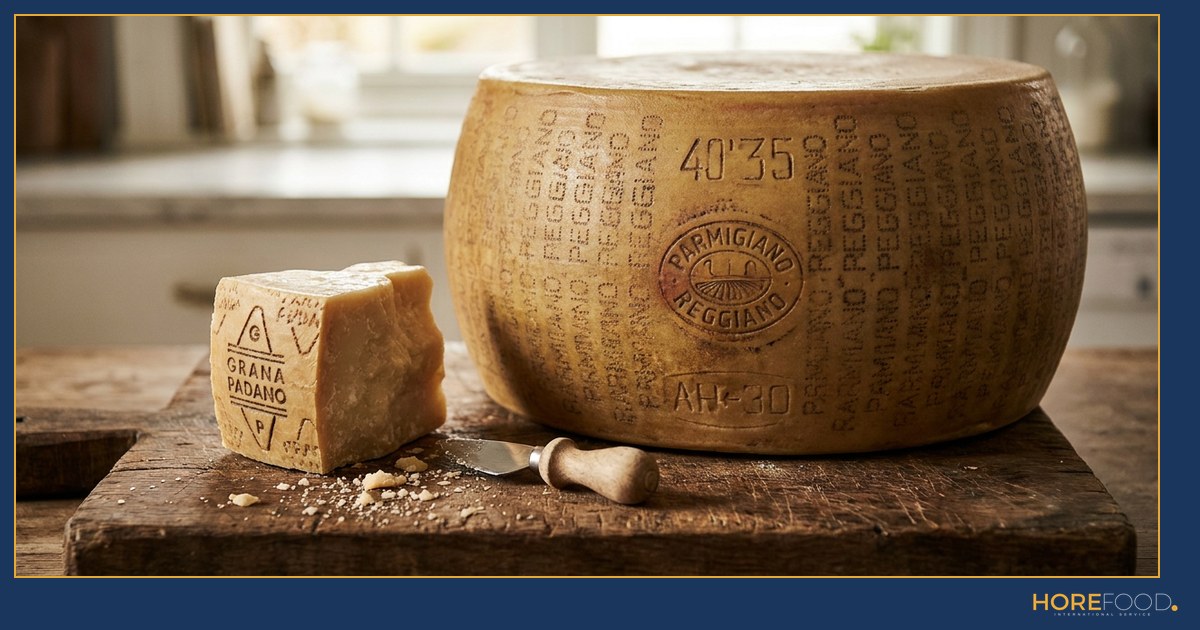
Parmigiano Reggiano and Grana Padano are the two great hard cheeses of northern Italy, and on a cheeseboard they look almost identical. But they are two separate PDO products with different rules — and if you buy Italian cheese for a restaurant, deli or import business, the difference between Parmigiano Reggiano and Grana Padano changes the flavour, the price and how you should use each one.
What is the difference between Parmigiano Reggiano and Grana Padano?
Both are PDO (Protected Designation of Origin) “grana” cheeses — hard, grainy, aged cow’s-milk cheeses made in northern Italy. The core differences are four: the production area, the minimum ageing, what the cows are allowed to eat, and whether additives are permitted. Parmigiano Reggiano follows the stricter rulebook; Grana Padano is made over a wider area under slightly more flexible rules.
Where does each cheese come from?
Parmigiano Reggiano can only be produced in a small, defined zone: the provinces of Parma, Reggio Emilia and Modena, plus part of Bologna (west of the Reno river) and part of Mantua (east of the Po). Grana Padano comes from the much larger Po river valley — 33 provinces across five regions (Piedmont, Lombardy, Veneto, Trentino-Alto Adige and Emilia-Romagna). The wider area is one reason Grana Padano is the best-selling PDO cheese in the world.
How long is each cheese aged?
Grana Padano must be aged at least 9 months, while Parmigiano Reggiano must be aged at least 12 months — and is frequently sold at 24, 30 or 36 months. The longer minimum ageing gives Parmigiano Reggiano more time to develop its crystalline, crumbly texture and deeper flavour.
What about the milk, feed and additives?
Parmigiano Reggiano is made only from milk, salt and rennet, with no additives allowed; the cows are fed grass and hay, and silage (fermented feed) is forbidden. Grana Padano permits the use of lysozyme, an enzyme from egg white, to control unwanted fermentation, and its cattle may be fed silage. This is also why Parmigiano Reggiano is naturally suitable for people who avoid egg-derived ingredients, while some Grana Padano is not.
| Parmigiano Reggiano | Grana Padano | |
|---|---|---|
| Area | Parma, Reggio Emilia, Modena + parts of Bologna & Mantua | Po valley — 33 provinces, 5 regions |
| Minimum ageing | 12 months (often 24–36) | 9 months |
| Additives | None (no lysozyme) | Lysozyme permitted |
| Cattle feed | No silage | Silage permitted |
| Flavour | Nuttier, complex, crumbly | Milder, sweeter, firmer |
Which one is better, and which should you use?
There is no absolute winner — it depends on the use and the budget. Parmigiano Reggiano tends to be more complex, nutty and crumbly, and is prized as a table and finishing cheese grated over a finished dish. Grana Padano is milder and sweeter, usually costs less, and is the workhorse for cooking, sauces and everyday grating. Many kitchens stock both for exactly this reason.
How can you tell you are buying the real thing?
Both cheeses are protected under EU quality law (Regulation (EU) No 1151/2012 on PDO/PGI), so the name on the rind is a legal guarantee, not marketing. Genuine wheels carry the consortium branding pin-dotted into the rind — “PARMIGIANO-REGGIANO” or “GRANA PADANO” repeated around the wheel — which stays visible even on a cut wedge. If a cheese is labelled only “hard cheese” or “Italian-style grated cheese”, it is not the PDO product.
How Horefood helps
Horefood supplies both Parmigiano Reggiano and Grana Padano PDO at wholesale, as whole wheels or pre-portioned formats, shipped across Europe by the box or the pallet. You order the certified product with its lot and traceability documentation, and we handle the paperwork on the Italian side. Horefood is a trade name of Horecarte B.V. (KvK 69696985).
Open your B2B account · browse cheese & dairy · talk to our team