


Food Traceability & Article 18 EU Law Explained

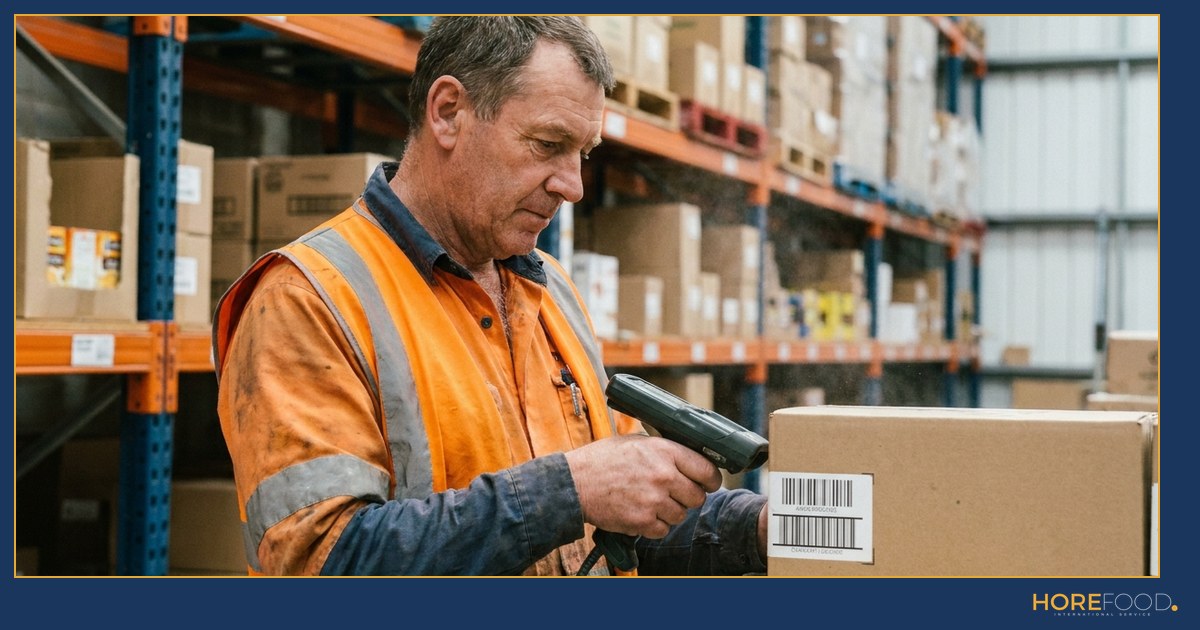
If you buy Italian food wholesale to resell in the EU, food traceability is not paperwork you can skip. This guide explains Article 18 of the EU General Food Law — the “one step back, one step forward” rule — and exactly which records a serious supplier should be able to give you.
This guide is general information, not legal advice. Food traceability duties depend on your role in the chain and your national authority. Always confirm current requirements with the competent authority and your own advisor.
What is food traceability?
Food traceability is the ability to trace and follow any food, feed or ingredient through all stages of production, processing and distribution. It is defined in the EU General Food Law, Regulation (EC) No 178/2002, and applies to every food business operator in the chain — producers, wholesalers, importers and retailers alike. The point is simple: when a product is found to be unsafe, authorities and businesses need to locate it and pull it back fast.
Traceability is a legal baseline, not a premium feature. It exists to protect consumers and to make product recalls and withdrawals workable across borders.
What does Article 18 of Regulation (EC) 178/2002 require?
Article 18 requires every food business to identify who supplied them and to whom they supplied their products. Operators must “be able to identify any person from whom they have been supplied with a food” (Article 18(2)) and “have in place systems and procedures to identify the other businesses to which their products have been supplied” (Article 18(3)). This information must be kept and made available to the competent authorities on demand.
In practice, this means keeping records that link each incoming batch to its source and each outgoing sale to its recipient. It applies from 1 January 2005 and covers all food and feed, without prejudice to stricter sector-specific rules.
What is “one step back, one step forward”?
“One step back, one step forward” means each business only has to trace its direct supplier and its direct customer — not the whole chain. You must know one step back (who you bought from) and one step forward (who you sold to). You are not legally required to trace beyond your own immediate links; the chain works because every operator holds its own two connections.
An important consequence for traders: “supply” means the transfer of ownership, not physical handling. A wholesaler that arranges direct delivery without ever touching the goods is still a supplier under Article 18 and still owes the one-step records.
Is that the same as internal or batch traceability?
No. Article 18 requires supplier-to-customer traceability, not internal batch-level traceability linking each specific lot to each specific customer. The European Commission’s guidance on the General Food Law treats internal traceability — recording which batch went to which buyer — as helpful but not compulsory under Article 18. So a recall is normally handled at the level of a consignment or delivery, not a surgically isolated lot, unless stricter sector rules (for example fishery products) apply.
Who applies the lot number and expiry date?
The producer applies the lot number and the date marking on the packaging, not the wholesaler. Under EU rules the batch/lot identification is the manufacturer’s responsibility (Directive 2011/91/EU) and the “best before” or “use by” date is set and printed by the producer under Regulation (EU) No 1169/2011. Your customer reads both directly on the carton. A wholesaler passes these through — it does not, and should not, relabel them.
What documents should a compliant supplier give you?
A compliant supplier should be able to document the one-step link between what they bought and what they sold to you. When you buy Italian food for resale, expect to receive or be able to obtain:
- An invoice and delivery note that clearly identify the products and quantities supplied to you.
- Enough product identification to tie the delivery to a source consignment (the supplier’s own “one step back”).
- Products whose packaging carries the producer’s lot number and date marking, intact and legible.
- Prompt contact and cooperation in the event of a recall or withdrawal, so the chain can be closed quickly.
Requests that go beyond the one step — for example a full CSV of lots and expiry dates per line — are a commercial arrangement, not a legal obligation under Article 18. A good supplier will still cooperate where it reasonably can.
Why does this matter for import and resale?
Traceability is what makes a recall workable and protects your business if something goes wrong upstream. If you resell Italian food, holding clean one-step records means you can respond to authorities, isolate an affected supply and demonstrate that you did your part. It also protects you commercially: a supplier that cannot document its sourcing is a risk you carry. For the wider paperwork of moving goods across the EU, see our guide on importing Italian food into the EU.
How Horefood helps
Horefood is an Italian food and beverage wholesaler — a trade name of Horecarte B.V. (KvK 69696985) — shipping across the EU by the box, layer or pallet. Every shipment leaves with documented one-step traceability: we record who we bought from and who we sold to, so your side of the chain is covered. The lot number and date marking travel on each producer’s packaging, exactly as EU rules require, ready for you to read on arrival. From our 10,000+ product catalogue — from pasta and preserves to cheese and cured meats — you receive goods with intact producer labelling and clean documentation. See how DOP marks and authenticity fit in with Parmigiano Reggiano vs Grana Padano, or browse our product categories.
Need a supplier with proper traceability behind every pallet? Open your B2B account · talk to our team.