


How to Buy Italian Food Wholesale Across the EU

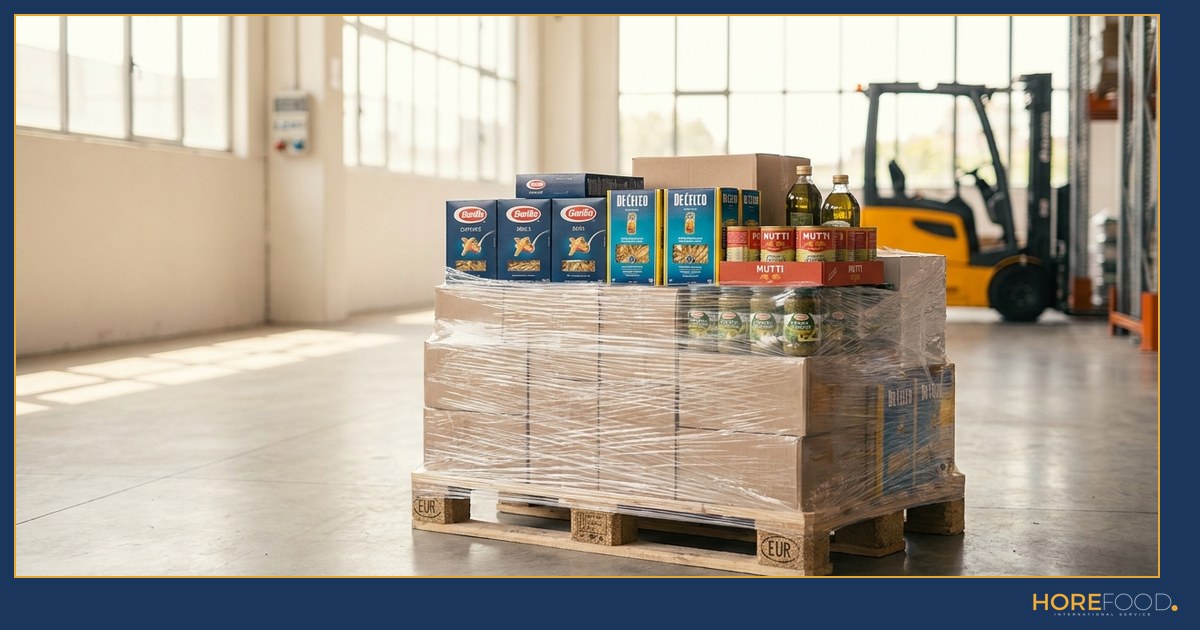
If you buy Italian food wholesale from another EU country, the transaction is simpler than most people expect: it is an intra-community acquisition, not a customs import. This guide explains the practical mechanics — no customs duties inside the single market, how VAT is handled, the documents you receive, ordering by box or pallet, and typical lead times.
This guide is general information, not legal or tax advice. Always confirm current requirements with the relevant authorities and your own advisor.
Is buying Italian food from Italy an import or an intra-community acquisition?
When a VAT-registered business in one EU country buys goods dispatched from another EU country, this is an intra-community acquisition — not a customs import. Goods move freely inside the single market, so there is no customs clearance and no import declaration for standard grocery products. In practice, a wholesaler in Hungary, Poland, Czechia or Germany buying Italian pasta, preserves or cheese receives the pallet the same way it would receive domestic stock, minus the border formalities. The rules change only for the United Kingdom, which is now outside the EU — see our guide on importing Italian food into the UK.
Are there customs duties inside the EU single market?
No. There are no customs duties on goods that are in free circulation and move between EU member states — that is the definition of the single market. You do not pay a tariff to bring Italian food from Italy into another EU country. Two things still apply: VAT (handled through the reverse charge, below) and excise duty on specific products such as wine and spirits, which move under excise suspension via the EMCS system with an electronic e-AD document. For alcohol specifics, see importing wine: excise duty and EMCS.
How does VAT work when you buy Italian food across the EU?
With a valid VAT number registered for cross-border trade, your Italian supplier invoices you at 0% and you account for VAT on the acquisition in your own country — this is the zero-rated intra-Community supply under Article 138 of the EU VAT Directive (2006/112/EC). The seller does not charge Italian VAT; you self-assess and, if you have full deduction rights, the amount nets to zero. Both parties must hold valid EU VAT numbers, and the supplier verifies yours through the official VIES system. For the full mechanics, read our dedicated guide on EU reverse-charge VAT on Italian food.
What documents do you receive when the pallet arrives?
You receive a clear paper trail that satisfies both accounting and food-law obligations. As the buyer, you should expect:
- Commercial invoice — showing the 0% reverse-charge line and your VAT number, for your intra-community acquisition reporting.
- Packing list — items, quantities, weights and how the pallet is built (boxes per line, layers).
- Transport document — CMR / delivery note evidencing the movement of goods between member states.
- Traceability data — lot number and best-before / use-by date, printed by the producer on each pack.
Under the EU General Food Law, Regulation (EC) 178/2002, Article 18, every food business must keep “one step back, one step forward” records — who it bought from and who it sold to. The producer applies the lot code and date on the packaging; the invoice and packing list complete your chain. More detail in food traceability under Article 18.
Should you order by box, layer or pallet?
You choose the unit that fits your rotation — box, layer or full pallet — and you can mix different references on the same pallet. Ordering by the box keeps your capital and shelf risk low on slow-moving lines; buying full pallets of your fast movers lowers your cost per unit and fills the truck efficiently. A standard EUR pallet is generally built to roughly 600 kg by weight or by volume, whichever it reaches first.
| Unit | Best for | Trade-off |
|---|---|---|
| Box (colli) | Testing lines, niche SKUs, small HoReCa | Highest cost per unit |
| Layer (strato) | Steady mid-volume sellers | Balanced |
| Full pallet (pedana) | Core, fast-moving stock | Needs storage + turnover |
Freight is charged by the pallet, so consolidating your order toward full pallets — and reaching a free-freight threshold where one applies — is usually the cheapest way to buy. See shipping for how pallets and thresholds work per destination.
How long does delivery take, and what do you need from your side?
Deliveries from the Northern Italy hub across the EU are typically fast — generally 1–2 working days of transit to Central and Eastern Europe once the order ships, though exact times depend on destination and volume. Goods are delivered to your door across Europe: we arrange transport with vetted carriers and charge it separately at cost. The applicable delivery terms are stated on each order confirmation, in accordance with our General Terms and Conditions of Sale. To start, you need just two things from your side:
- A valid EU VAT number registered for intra-community trade (checkable in VIES).
- A delivery address that can receive a pallet.
How Horefood helps
Horefood is a B2B wholesaler of Italian food and beverage — a trade name of Horecarte B.V. (KvK 69696985, VAT NL857972145B01, Reeuwijk, NL). We carry 10,000+ references across pasta and rice, preserves, delicatessen, cheese, cured meats, antipasti, condiments and beverages, and we ship anywhere in the EU by box, layer or full pallet, mixing references freely on one pallet. We handle the export paperwork on the Italian side and invoice qualifying buyers at 0% under the reverse charge, once your VAT number is validated in VIES. You receive invoice, packing list, transport document and producer lot/date data with every shipment.
Ready to source authentic Italian food? Open your B2B account · browse the catalogue · check shipping · talk to our team.
Sources
- Your Europe — Cross-border VAT (selling goods to businesses in another EU country)
- Your Europe — Check a VAT number (VIES)
- European Commission — VIES VAT number validation
- EUR-Lex — Regulation (EC) No 178/2002 (General Food Law, Article 18 traceability)
- EUR-Lex — VAT Directive 2006/112/EC (Article 138 intra-Community supplies)