


Prosecco vs Champagne: Real Differences for Buyers

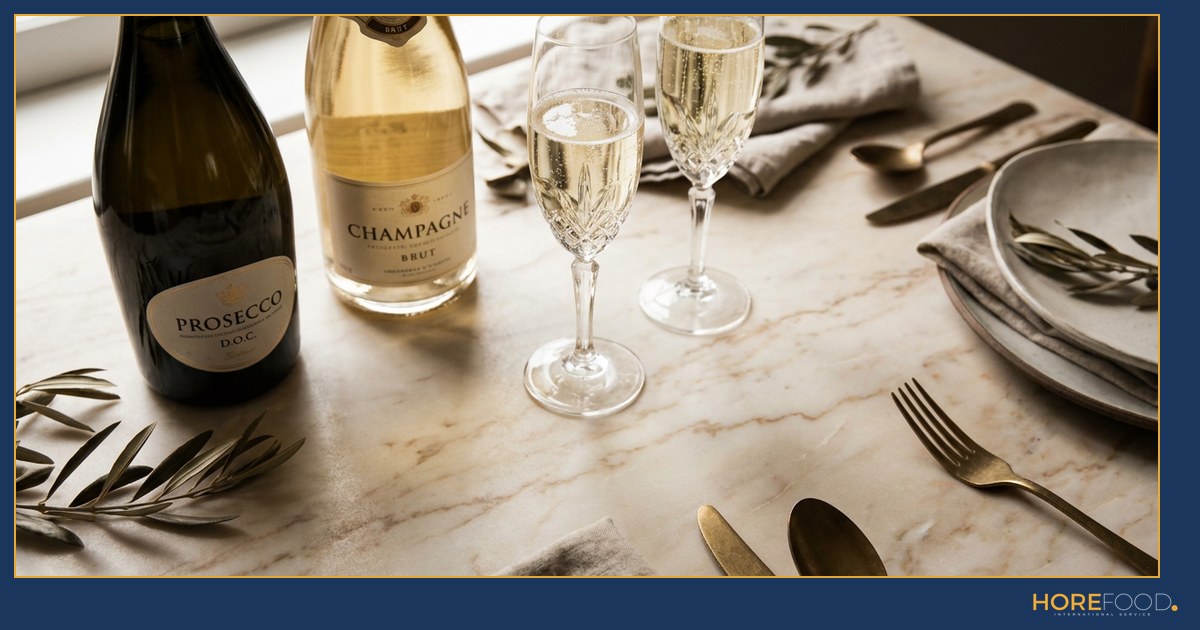
If you stock Italian sparkling wine, “Prosecco vs Champagne” is not a matter of taste — it is a matter of method, grape, region and legal status. This guide explains the real differences, so you can position, price and describe each bottle correctly for your customers.
What is the real difference between Prosecco and Champagne?
Prosecco and Champagne are both sparkling wines, but they are made by different methods, from different grapes, in different protected regions of two different countries. Prosecco is Italian, made mainly from the Glera grape, and gets its bubbles from a second fermentation in pressurised steel tanks (the Charmat/Martinotti method). Champagne is French, made from Chardonnay, Pinot Noir and Meunier, with a second fermentation inside the bottle (the traditional method, or méthode champenoise). Both names are protected designations of origin — neither is a generic style.
| Feature | Prosecco | Champagne |
|---|---|---|
| Method | Charmat / Martinotti (tank second fermentation) | Traditional method (bottle second fermentation) |
| Main grape | Glera (min. 85%) | Chardonnay, Pinot Noir, Meunier |
| Country / region | Veneto & Friuli Venezia Giulia, Italy | Champagne AOC, France |
| Protected status | Prosecco DOC; Conegliano Valdobbiadene & Asolo DOCG | Champagne AOC (PDO) |
| Typical style | Fresh, floral, fruit-forward | Structured, autolytic, aged on lees |
| Price positioning | Generally more accessible | Generally premium |
How is Prosecco made, and why does the Charmat/Martinotti method matter?
Prosecco gets its bubbles from a second fermentation in large sealed stainless-steel tanks (autoclaves), a process known as the Charmat or Martinotti method. The method was developed by Federico Martinotti in the late 19th century and industrialised with Eugène Charmat’s pressurised tanks. Because fermentation happens in bulk rather than bottle by bottle, the method is faster and less labour-intensive than Champagne’s, which is a key reason Prosecco reaches the shelf at a more accessible price. It also preserves the fresh, floral, fruit-forward character buyers expect from Glera, according to the Consorzio Tutela Prosecco DOC.
What grapes and regions define each wine?
Prosecco must be made predominantly from Glera (at least 85%), grown across nine provinces of Veneto and Friuli Venezia Giulia; Champagne is a blend of Chardonnay, Pinot Noir and Meunier grown inside the delimited Champagne appellation in France. This is the core of why the two are not interchangeable. The names are tied to place and rules, not just to fizz:
- Prosecco DOC — the broad denomination covering Veneto and Friuli Venezia Giulia.
- Conegliano Valdobbiadene Prosecco Superiore DOCG — the historic hillside heart of production.
- Asolo Prosecco DOCG — the second DOCG zone.
- Champagne AOC — a single protected French region, all bottles made by the traditional method, per the Comité Champagne.
Prosecco frizzante vs spumante: what is the difference?
The difference between frizzante and spumante Prosecco is the amount of pressure — and therefore how the wine is legally classified and labelled. Under EU wine law (Regulation (EU) No 1308/2013, Annex VII), a “sparkling wine” (spumante) carries a CO₂ pressure of at least 3 bar, while a “semi-sparkling wine” (frizzante) sits between 1 and 2.5 bar. For Conegliano Valdobbiadene, the disciplinare sets spumante at a minimum of 3 bar and frizzante at a maximum of 2.5 bar. In practice:
- Spumante — fully sparkling, persistent mousse; the format most customers picture when they say “Prosecco”.
- Frizzante — gently sparkling, softer bead, often a lower price point.
- Tranquillo — a still version exists too, but is rare outside the production area.
Why isn’t Prosecco just “generic sparkling”?
Prosecco is a Protected Designation of Origin, not a production style, so a tank-method sparkling wine made outside the delimited zone cannot legally be called Prosecco. Only wine made from Glera, in the registered provinces of Veneto and Friuli Venezia Giulia, under the DOC or DOCG rules, may use the name — this is enforced by the Consorzio di Tutela Conegliano Valdobbiadene Prosecco Superiore DOCG. When you resell, this matters commercially: authentic Prosecco carries the DOC/DOCG on the label, and generic “sparkling wine” or “Charmat method fizz” from elsewhere is a different product at a different value.
What should you know when you stock and resell Italian sparkling?
For a reseller, the practical points are legal category, denomination and excise — get these right and pricing and positioning follow. Keep these in view:
- Check the label: DOC vs DOCG, and spumante vs frizzante, define both quality tier and shelf price.
- Prosecco is designed for freshness — rotate stock and sell young rather than cellar it.
- Wine is an excise good: within the EU it moves under duty suspension via EMCS with an e-AD, and duty is due in the country of consumption. See our guide on importing wine, excise duty and EMCS.
- Understand the classification system before you build a range — see Italian wine classification: DOCG, DOC and IGT explained.
How Horefood helps
Horefood is an Italian food & beverage wholesaler (a trade name of Horecarte B.V., KvK 69696985, BTW NL857972145B01) that ships across the EU on pallets. We carry Italian sparkling wine — including Prosecco DOC and DOCG — in our wine catalogue, alongside 10,000+ Italian references you can mix on a single pallet. As an excise good, wine moves under duty suspension through EMCS with an e-AD, and we handle the paperwork on the Italian side. Talk to us about building an Italian sparkling range that fits your market and margins.
Open your B2B account · browse the wine catalogue · talk to our team.
Sources
- Consorzio Tutela Prosecco DOC — Glera, Charmat/Martinotti method, denomination.
- Consorzio di Tutela Conegliano Valdobbiadene Prosecco Superiore DOCG — DOCG rules, spumante vs frizzante.
- Comité Champagne (CIVC) — Champagne AOC, grapes, traditional method.
- Regulation (EU) No 1308/2013, Annex VII — EU categories of sparkling and semi-sparkling wine (pressure).