


How to Choose a Reliable Italian Food Supplier

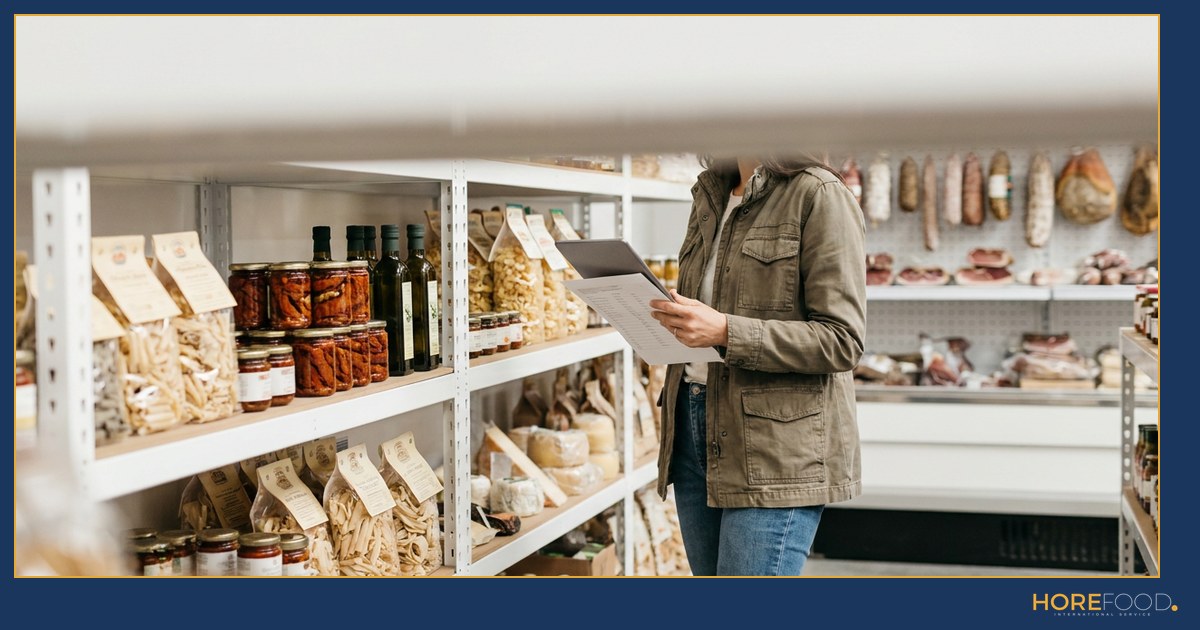
Choosing a reliable Italian food wholesale supplier is a due-diligence exercise, not a leap of faith. If you run a restaurant, a deli or an import business, this checklist shows you exactly what to verify before you place a first order: legal identity and VAT, traceability, food-safety certifications, product authenticity, minimum orders, shipping terms and references.
How do you check an Italian food supplier is a real, legitimate company?
Start by confirming the supplier is a registered company with a valid VAT number, because a legitimate wholesaler will publish its legal name, company registration and VAT ID openly. Ask for the registered business name (which may differ from the trade name you see on the website), the company registration number, and the VAT number. Then verify the VAT number yourself in the official EU VIES system. A VAT number that validates in VIES is also what makes 0% intra-community invoicing possible under the reverse-charge rules — see our guide on EU reverse-charge VAT on Italian food.
- Registered legal name + trade name (they can differ).
- Company/chamber-of-commerce registration number.
- VAT number — check it in VIES, don’t take it on trust.
- A real physical address and a named contact, not just a web form.
What certifications and traceability documents matter?
A serious food wholesaler operates under HACCP food-safety principles and can trace every product one step back and one step forward, as required by EU food law. Under the EU General Food Law (Regulation (EC) 178/2002, Article 18), every operator must be able to identify who supplied a product and to whom it was sold. Hygiene and HACCP obligations sit in Regulation (EC) 852/2004. Ask what the supplier can document.
- HACCP — the baseline food-safety management standard in the EU.
- Traceability — lot number and expiry per item, so a batch can be withdrawn if needed. More on this in our guide to food traceability under Article 18.
- Voluntary schemes — BRCGS or IFS certification is common for larger operators and reassuring, though not legally mandatory.
- Product documents — technical data sheets, allergen information and, on request, certificates of analysis.
How do you judge product range and authenticity?
Authenticity is verifiable: genuine Italian specialities carry DOP or IGP marks tied to a legal register, so a credible supplier can tell you which of its products are protected and which are not. Under the EU geographical indications scheme, PDO/PGI (DOP/IGP) names are protected and listed in an official register. This matters because a large share of “Italian” food sold abroad is Italian-sounding imitation, not the real product. Look for depth in the categories you actually sell — pasta and rice, preserves, cured meats, cheese, antipasti, condiments, sweets and beverages — rather than a thin, generic list.
What about minimum orders, box vs pallet, and shipping?
Minimum order quantity (MOQ), pack format and shipping terms are commercial terms, not regulations, so compare them supplier by supplier. Clarify whether you can buy by the box, by the layer or by the full pallet, and whether you can mix different products on the same pallet. Then pin down the shipping terms in writing.
- MOQ — the smallest order accepted (per line and per shipment).
- Pack format — box, layer or pallet; whether a mixed pallet is allowed.
- Delivery terms — check how transport, risk and unloading are allocated in the supplier’s terms and on the order confirmation; confirm who handles what.
- Free-freight threshold — the order value at which shipping is included, which varies by destination country.
- Lead time — realistic transit days to your region, in writing.
If you import into a non-EU market such as Great Britain, remember that becomes an extra-EU export with customs and SPS checks — see importing Italian food into the UK, and importing Italian food into the EU for the intra-EU picture.
How do you check references and test a new supplier?
The safest way to qualify a supplier is a small trial order before you commit volume, combined with independent references. Ask for two or three existing B2B customers in a similar segment, look for reviews or trade signals, and place a first order that is large enough to judge quality and service but small enough to absorb if something goes wrong. Check the delivered goods against the paperwork: correct lots, sound expiry dates, intact packaging, accurate invoice.
| Checklist item | What good looks like |
|---|---|
| Legal identity + VAT | Name, registration and VAT number published; VAT valid in VIES |
| Traceability | Lot + expiry per item; one-step-back/forward records |
| Food safety | HACCP in place; BRCGS/IFS a plus |
| Authenticity | DOP/IGP products identified; genuine, not “Italian-sounding” |
| Ordering | Clear MOQ; box / layer / pallet; mixed pallets allowed |
| Shipping | DAP terms, free-freight threshold, realistic lead time in writing |
| References | Contactable B2B customers; successful trial order |
How Horefood helps
Horefood is an Italian food and beverage wholesaler — a trade name of Horecarte B.V. (KvK 69696985, VAT NL857972145B01), an EU-registered company in the Netherlands with its sourcing and logistics base in Northern Italy. Our catalogue holds 10,000+ references across pasta and rice, preserves, cured meats, cheese, antipasti, sweets, beverages and more. Every product carries the producer’s lot and expiry for traceability, and we ship across the EU by the box, layer or pallet, with mixed pallets allowed. For businesses with a valid VIES VAT number, we invoice at 0% as an intra-Community supply (Article 138). Prices and stock are visible in a self-service B2B account.
Ready to vet us against your own checklist? Open your B2B account · browse the catalogue · see shipping · talk to our team.