


EU reverse-charge VAT explained: buying Italian food across the EU

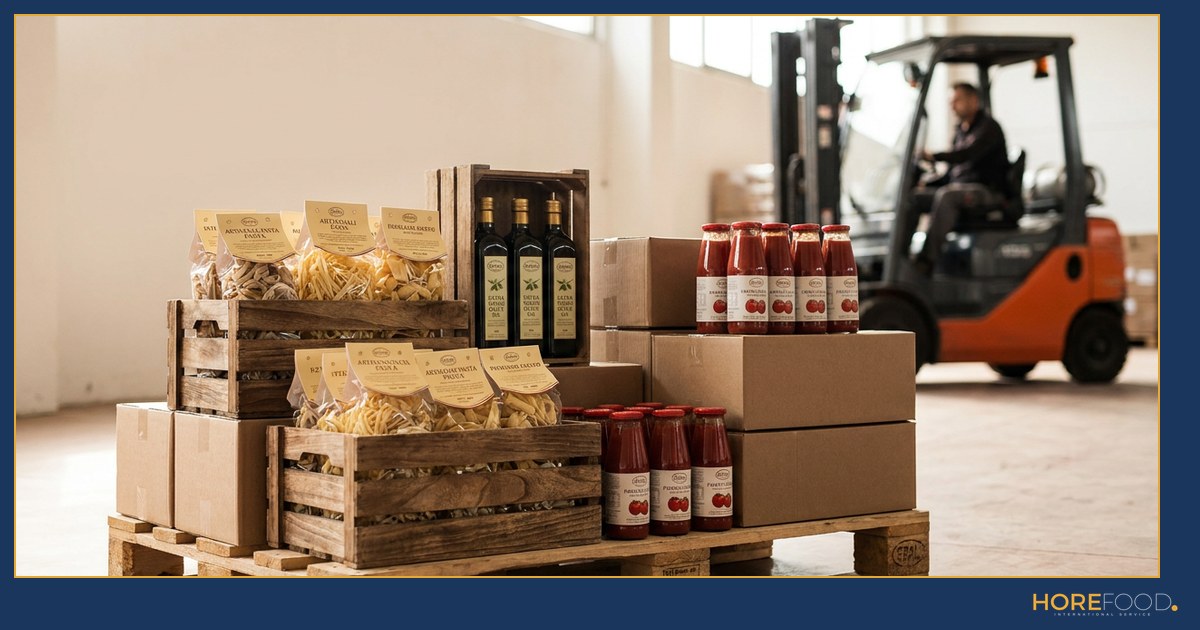
If you buy Italian food wholesale from a supplier in another EU country, VAT works differently than on a domestic purchase. In most cases the supplier invoices you at 0% and you account for the VAT in your own country. This is the EU reverse charge, and understanding it tells you exactly what to give your supplier and what to keep for your records.
This guide is general information for B2B buyers, not tax advice. Confirm your own position with your accountant.
How does VAT work when buying food from another EU country?
When a business in one EU country sells goods to a VAT-registered business in another, it is an intra-community supply — not a customs import. There are no customs duties inside the EU single market, but VAT still applies: instead of the seller charging its local VAT, the liability is shifted to you, the buyer, under the reverse charge.
What is the reverse charge?
With an intra-Community supply of goods, the VAT is accounted for by the buyer in the country of arrival. Under Article 138 of the EU VAT Directive (2006/112/EC), when both parties have a valid EU VAT number and the goods move to another Member State, the supplier issues the invoice at 0% and you declare both the output and input VAT in your own country’s return — usually a nil net effect. Your Italian supplier does not charge you Italian VAT.
Why do you need a valid VAT number in VIES?
The 0% reverse charge only applies if your VAT number is valid in VIES, the official EU VAT number validation system run by the European Commission. Your supplier is expected to check it before invoicing at 0%. If your number cannot be verified, the supplier may have to charge VAT instead — so keeping your VIES registration active and correct is what protects the 0% treatment.
What do you need to do as the buyer?
- Be VAT-registered for intra-community trade in your country.
- Give your supplier your full VAT number before the invoice is issued.
- Make sure your number is valid in VIES.
- Keep the invoice, which should note the reverse charge (e.g. “intra-Community supply, Art. 138 Directive 2006/112/EC”).
- Declare the acquisition in your national VAT return.
Is buying Italian food across the EU an import?
No — trade between EU member states is an intra-community acquisition, not a customs import. You will not face customs clearance or import duty on goods moving within the single market. Customs only enters the picture for countries outside the EU, such as the United Kingdom after Brexit, which is a separate process.
What about excise goods like wine?
Wine and spirits are excise goods, so they follow an additional set of rules on top of VAT. Excise products move under duty suspension through the EU’s EMCS system with an electronic administrative document (e-AD), and the excise duty is due in the country of consumption. If your order includes wine, plan for this separately from the VAT treatment above.
How Horefood helps
Horefood is an Italian food and beverage wholesaler that ships across the EU, and we handle the export paperwork on the Italian side. For VAT-registered EU buyers with a valid VIES number, orders are invoiced at 0% under the reverse charge; the goods ship by the box or the pallet. Horefood is a trade name of Horecarte B.V., VAT NL857972145B01, KvK 69696985.
Open your B2B account · browse the catalogue · how shipping works